
012026 World Cup basics: a new 48-team, 12-group, 104-match landscape
The 2026 World Cup runs from 11 June to 19 July 2026, co-hosted for the first time by the USA, Canada and Mexico. It is the biggest expansion since 1998, with the field rising from 32 to 48 teams in 12 groups of four, and the total jumping from 64 matches to 104. Matches are spread across 16 host cities — 11 in the USA, 3 in Mexico and 2 in Canada.
On format, the top two of each group plus the 8 best third-placed teams reach the new round of 32, then play through to the final. Teams reaching the final four play 8 matches in the tournament rather than 7 — a fresh test of fitness and squad depth.

02Title favorites: which powers are most fancied
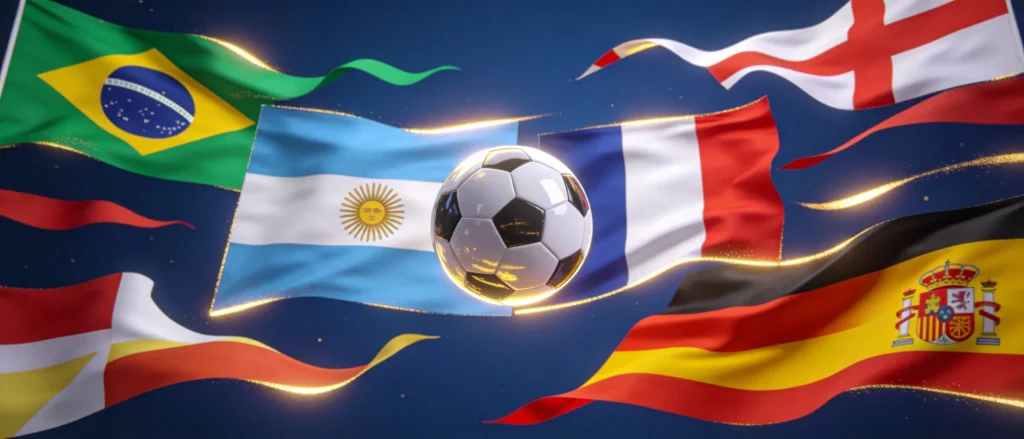
Per FIFA’s world ranking published in April 2026, France returned to world number one for the first time since September 2018, with Spain and Argentina second and third and England fourth. Rankings and odds differ slightly, though, with many bookmakers and data firms instead viewing Spain as the most fancied side.
- Spain: with a young core of Yamal, Pedri and Rodri and a mature possession system, rated by many models as having the highest title probability.
- France: a complete squad with deep tournament experience, currently world number one, seen as one of the steadiest contenders.
- England: boasting stars like Bellingham and Rice, tipped as having the second-highest chance of reaching the quarter-finals.
- Argentina: the defending champions, with Messi possibly at his last World Cup, chasing the first back-to-back title since Brazil in 1962.
- Brazil: the most fancied traditional power outside Europe, with the five-time champions’ pedigree intact.
03Confederation representatives: how the 48-team map breaks down
With expansion, each confederation’s allocation has been adjusted significantly. Europe (UEFA) gets the most direct places at 16; Africa (CAF) 9; Asia (AFC) 8; South America (CONMEBOL) and North/Central America (CONCACAF) have their base allocations; and Oceania (OFC) gains a guaranteed place for the first time. The USA, Canada and Mexico qualify automatically as hosts. The remaining places are decided through inter-confederation play-offs.
The allocation gives more non-traditional footballing nations a place on the world stage, raising the tournament’s global reach and unpredictability. The actual group matchups and draw results follow the official announcement.
04Potential dark horses: do not underestimate these teams
The World Cup’s appeal often comes from teams that defy expectations. Based on recent form and squad depth, these sides are worth watching:
- Morocco: reached the semi-finals in Qatar, beating Spain and Portugal along the way; disciplined and organized, and now firmly ranked among the upper tier rather than a mere surprise package.
- Netherlands: with a Van Dijk-led defense and tactical flexibility, considered a side the market may underrate.
- Croatia: if veteran Modric features, it could be his international swansong; experience and resilience are long-standing strengths.
- Germany: technically gifted next-generation talents like Musiala and Wirtz mean their quality should not be underestimated.

05Tactical trends: transition and pressing decide outcomes
Across pre-tournament analysis, the tactical focus for 2026 centers on fast attacking transitions, high pressing, and players’ composure and defensive recovery in key moments. Teams that stay stable under pressure and exploit the instant an opponent’s shape loosens will hold an edge in both the group stage and the knockouts. With a denser schedule and more matches, squad depth and rotation may matter more than in any previous edition.
06In closing
Under the new format, the 2026 World Cup is full of variables, and the line between traditional powers and dark horses is increasingly blurred. This power analysis is for fans’ pre-tournament reference only and is not betting advice; the exact schedule, groups, scores and rules all follow the latest official announcements from FIFA and the tournament organizers.
FAQ
Who are the favorites to win the 2026 World Cup?
Traditional powers such as Brazil, Argentina, France, England, Spain and Germany are widely seen as the favorites.
Which teams could be dark horses?
Helped by the 48-team expansion, fast and well-organized emerging sides have more chance of group-stage upsets.
Who are the defending champions?
Argentina won the 2022 World Cup, and whether they can defend the title is one of this edition's storylines.
Can this power analysis be used for betting?
No. It is objective pre-tournament analysis and information, for reference only, and does not constitute betting advice.
Related Articles
 Team Analysis
2026 World Cup Star Players to Watch: A Guide to the Game’s Biggest Names
The 2026 World Cup is co-hosted by the USA, Canada and Mexico, running 11 June–19 July. This guide rounds up the star players to watch — from Messi and Mbappe to Haaland and Bellingham — with an objective look at today's biggest names and the storylines;…
 World Cup Guide
2026 World Cup New Format Explained: 12 Groups, 104 Matches and the New Round of 32
The 2026 World Cup format gets a full upgrade — from 32 to 48 teams, a 12-group system, the total rising to 104 matches and a new round of 32. This article explains the qualification rules, the changes in matches and the three-nation hosting; schedule per…
 World Cup Guide
2026 World Cup Tickets Guide: Sales Phases, Official Channels, Price Tiers and Avoiding Scams
How do you buy 2026 World Cup tickets? This guide covers FIFA's official sales phases, official purchasing channels, price tiers and key anti-scam points to help fans buy safely. Sales timing and prices follow FIFA's official announcements; avoid counterfeit tickets.